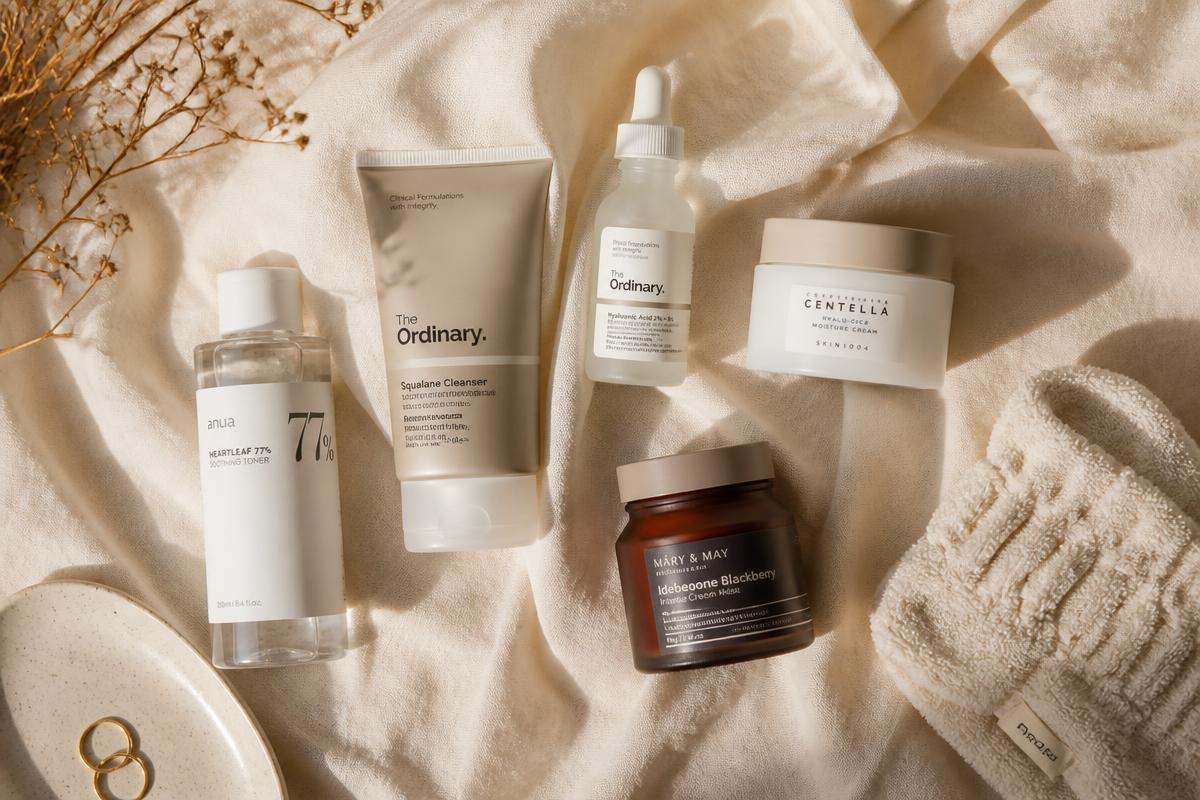
The 5 Ingredients Every Routine Needs
From hydrators to antioxidants, these powerhouse ingredients deliver visible results without the hype.

Five ingredients do most of the work
Skincare marketing runs on novelty, but the ingredients with genuine evidence behind them have barely changed in a decade. Five of them cover almost every common concern. Get these right and the rest of your shelf is refinement.
1. Hyaluronic acid — hydration you can feel immediately
Hyaluronic acid is a humectant: it binds water and holds it in the upper layers of skin, plumping the look of fine lines and restoring bounce. It works best on slightly damp skin and it needs something on top of it — a moisturizer or cream — to keep that water from evaporating. Used alone in a dry climate, a hyaluronic serum can actually feel tightening, which is why we always pair it with a barrier cream.
Use it: morning, evening, or both. It plays well with every other ingredient on this list.
2. Niacinamide — the quiet multi-tasker
Vitamin B3 is the most versatile ingredient in skincare. It helps regulate oil production, visibly refines the look of pores, supports the barrier by encouraging ceramide production, and calms the redness left behind by breakouts. It's also unusually well tolerated — most sensitive skin does fine with it around 4–5%, where very high concentrations can cause flushing.
Use it: morning or evening. If your skin is oily or congested, this is often the single best first active.
3. Vitamin C — brightness and daytime defence
A well-formulated vitamin C serum does two things: it neutralizes free radicals generated by UV and pollution, and it interrupts the pigment pathway that leaves dark spots behind. Over six to twelve weeks it makes skin look more even and less dull. It's also the ingredient most sensitive to light and air, which is why it belongs in an opaque bottle and why a formula that has turned deep orange has passed its useful life.
Use it: morning, under sunscreen, where its antioxidant role matters most.
4. Retinol and retinal — the texture and aging standard
Retinoids speed cell turnover and signal for collagen, which is why they remain the most evidence-backed option for fine lines, uneven texture, and post-acne marks. Retinal (retinaldehyde) converts to the active form in fewer steps than retinol, so it tends to work a little faster at comparable tolerability. Both need a slow start — twice weekly, at night, over moisturizer if you're sensitive — and both make daily sunscreen non-negotiable.
Use it: evening only, two to seven nights a week depending on how your skin responds.
5. Ceramides — the ingredient that holds everything together
Ceramides are the lipids that make up a large share of your skin's barrier. When they're depleted — by over-cleansing, cold weather, or too many actives at once — skin loses water, stings when you apply things, and looks red and rough. Replacing them restores comfort quickly and makes every active you use more tolerable. If your skin has been irritated by a new routine, a ceramide cream is the fix, not another treatment.
Use it: evening at minimum, morning too if your skin is dry.
How to combine them
A simple, complete pairing: vitamin C serum in the morning under sunscreen; retinal at night; hyaluronic acid and a ceramide moisturizer in both routines; niacinamide wherever it fits. Avoid stacking a retinoid and a strong exfoliating acid on the same night when you're starting out, and if something stings persistently, drop back to cleanse-moisturize-protect for a week before rebuilding.
Everything else — peptides, azelaic acid, exfoliating acids — can be worthwhile. But they're additions to this core, not substitutes for it.