How to Build a Skincare Routine That Sticks
Start simple. A consistent cleanse-treat-moisturize-protect routine beats a complicated one you abandon.
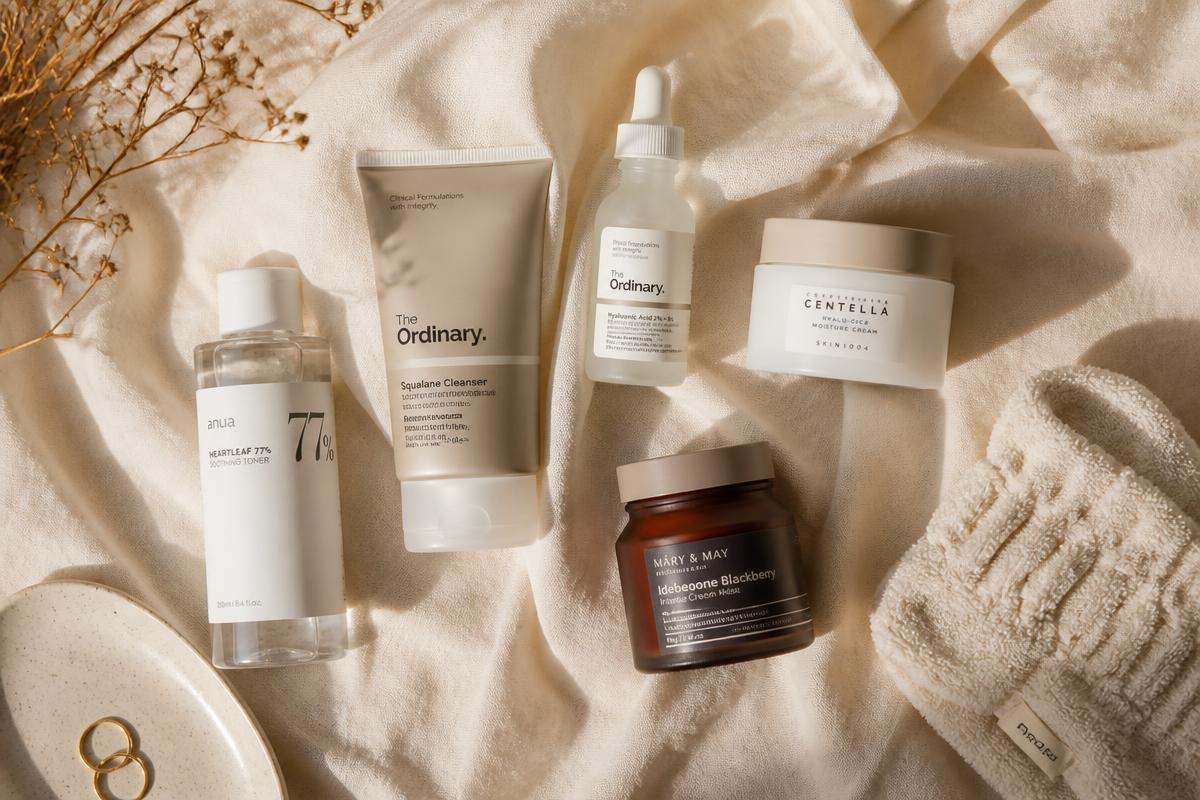
Start with four steps, not fourteen
The most common reason a skincare routine fails isn't the products — it's the length. A twelve-step ritual feels aspirational on a Sunday evening and impossible on a Tuesday at 11pm. Skin doesn't reward ambition; it rewards repetition. So we build every Lumière routine around four jobs: cleanse, treat, moisturize, protect. Everything else is optional refinement you can add later, once the foundation is automatic.
Cleansing removes the sunscreen, sweat, and pollution of the day so what follows can actually absorb. Treating is where your active ingredient goes — the serum chosen for your specific concern. Moisturizing seals in water and supports the barrier. Protecting, in the morning, is sunscreen. Four steps, under two minutes, twice a day.
Choose products for your skin, not for the internet
Before you buy anything, spend a week noticing how your skin actually behaves. A few hours after cleansing, does it feel tight and papery, shiny across the T-zone, or simply comfortable? Does it flush easily? Are breakouts clustered around the chin, or scattered? These observations are worth more than any trend cycle, because they tell you which texture and which active you need.
Dry and sensitive skin wants creamy cleansers, ceramides, and hydrators like hyaluronic acid and glycerin. Oily or congested skin does better with gel cleansers, niacinamide, and a well-formulated salicylic acid. If dullness and dark spots are your concern, vitamin C in the morning is the shortest path to visible change. If it's fine lines and texture, retinal or retinol at night is the ingredient with the deepest evidence behind it.
Introduce actives one at a time
The fastest way to end up with a compromised barrier is to start three new actives on the same night. Add one product, use it for two to three weeks, and watch. Mild tingling that fades in a minute can be normal for an acid; stinging, persistent redness, or flaking that doesn't settle is a signal to back off — reduce frequency to twice a week, or buffer the active by applying it over moisturizer.
Retinoids in particular need patience. Start twice a week, move to alternate nights after a month, and only go nightly if your skin stays calm. Consistency at a low frequency beats a two-week sprint followed by a month of recovery.
Make it frictionless
Habits stick when they're attached to something you already do. Keep your morning products beside your toothbrush and your evening products where you undress, not in a cabinet you have to open. Buy the size you'll actually finish. If your routine takes longer than brushing your teeth, it's probably too long for a weeknight.
Give yourself a bare-minimum version for exhausted nights: cleanse and moisturize. Skipping the serum once is nothing. Skipping the whole routine for three weeks because it feels like a chore is the thing that actually costs you progress.
Measure in months, not days
Hydration improves in days. Texture and brightness take four to six weeks. Fine lines and pigmentation take three months or more, because you're waiting on cell turnover and collagen, and those move on their own schedule. Take a photo in the same light every few weeks — memory is a poor judge of gradual change, and photos will show you progress your mirror won't.
If you'd rather not assemble this yourself, our routine quiz asks three questions about how your skin behaves and returns a specific morning-and-night sequence from our catalogue. Start there, use it for a month, then adjust one thing at a time.